Real-World Examples
See how our engines handle actual handwritten notes — from English sticky notes to Korean cursive.
Handwritten To-Do on a Sticky Note
Quick bullet-point list written in English cursive on a pink Post-it note. Both engines handle Latin handwriting well, so the Cost/Benefit model is the smart choice.
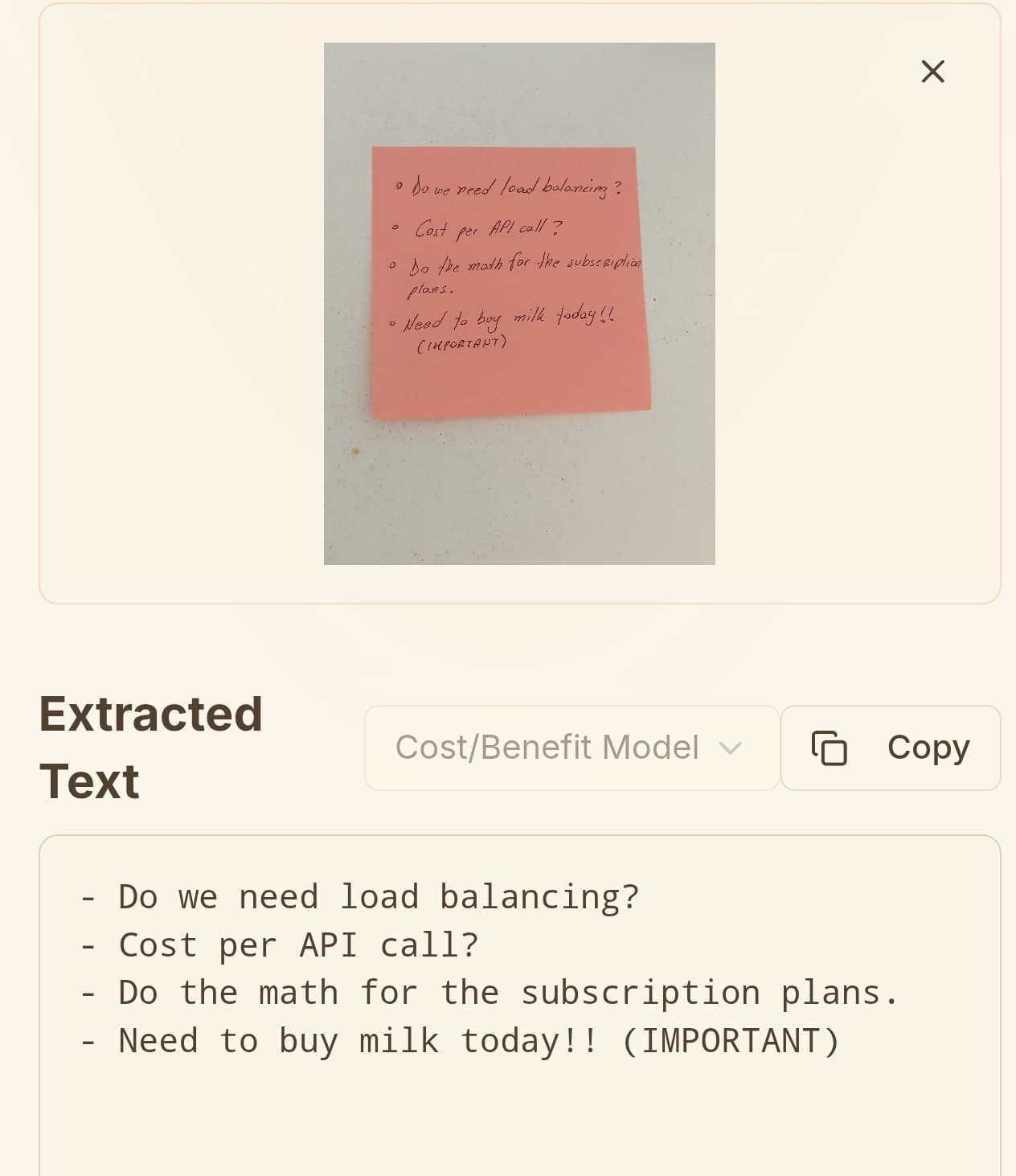
Cost/Benefit Model (Mistral)
Perfect extraction of all four bullet points. Clear Latin handwriting is well within Mistral's capabilities — no need for the heavier model.
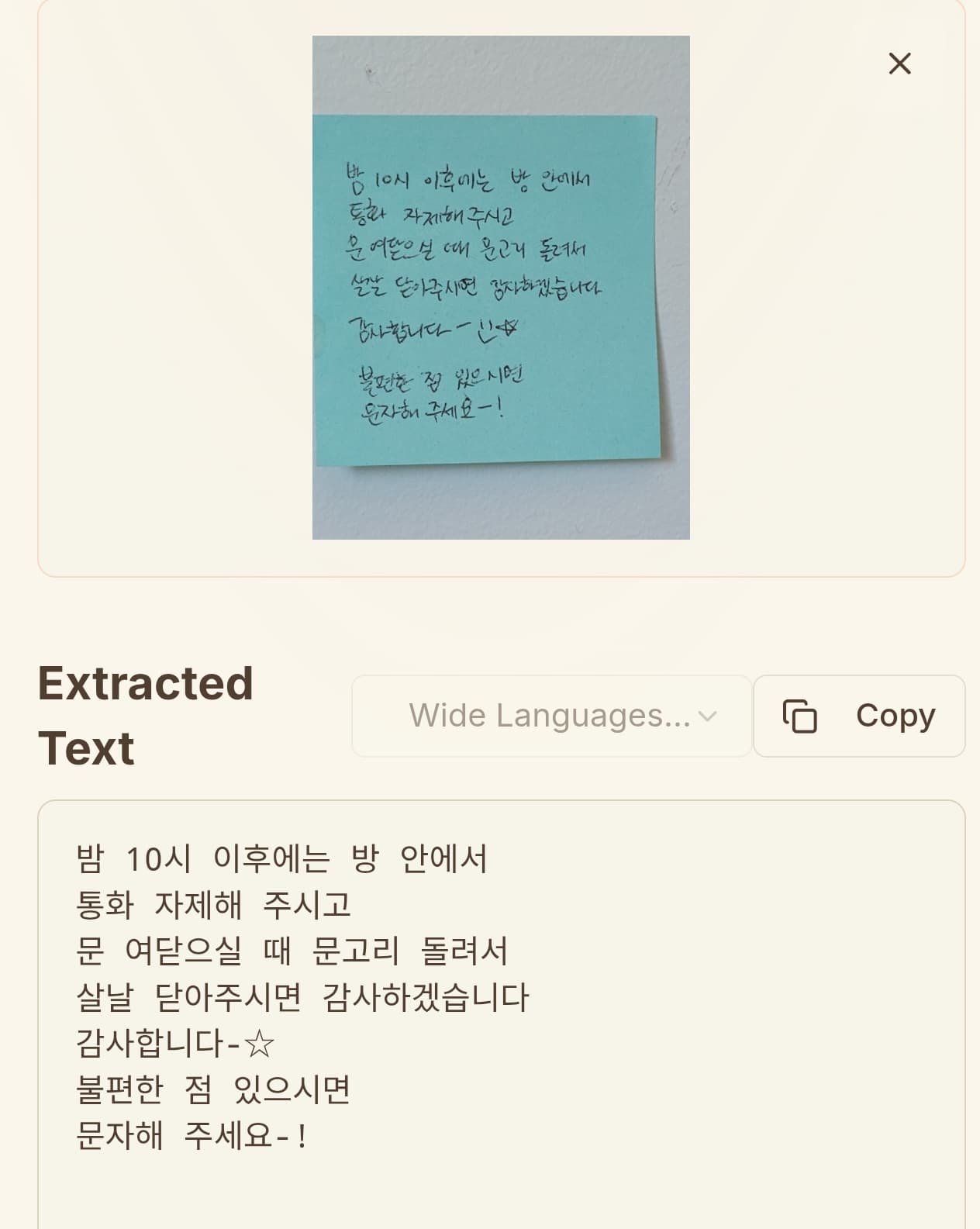
Handwritten Korean Notice
A green sticky note with Korean cursive — room etiquette rules. This is where the Wide Languages model shines, correctly parsing every Hangul character and contextual nuance.
Cost/Benefit Model (Mistral)
Struggles with non-Latin handwriting. May hallucinate characters or produce incomplete output due to limited training on Asian scripts.
Wide Languages Model (Gemini)
Flawless extraction. Understands stroke order and context of handwritten Korean across all character forms.
Which engine should you use?
Cost/Benefit (Mistral)
Use for English, Spanish, French, and other Latin-script documents. Fast and cost-efficient for clear printed text, screenshots, and standard handwriting.
Wide Languages (Gemini)
Use for Korean, Japanese, Mandarin, Arabic, Hindi, or any messy/degraded handwriting. Higher API cost, but elite accuracy on complex inputs.